
 Customer Acquisition
 Paid Ads
 CRO Strategy
 Landing Pages
 Website Design
 Case studies
 Blog
Blog Results
 Templates



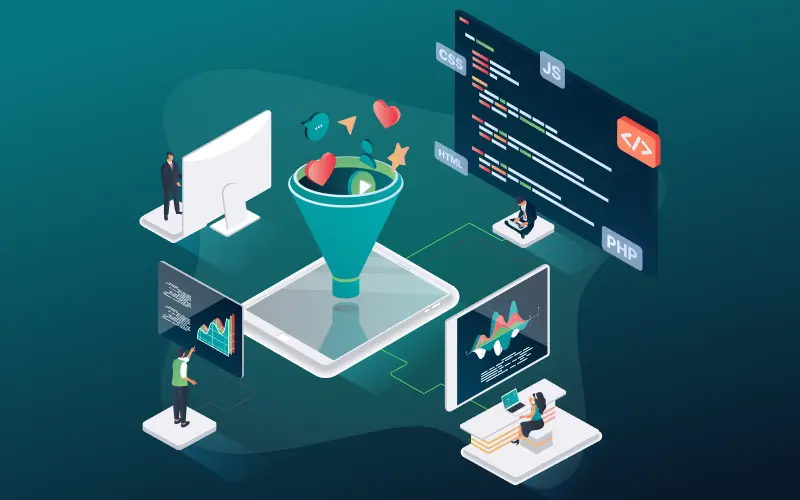
Most SaaS teams jump into channels before they build a real strategy. They launch ads, push content, run webinars, and hope something sticks. The problem isn’t the effort. It’s that none of it sits inside an actual funnel that moves buyers from first touch to revenue.
A SaaS marketing funnel works differently from a traditional one. You’re not selling a one-time product. You’re working with recurring revenue, activation moments, retention goals, expansion opportunities, and long buying cycles. If the funnel isn’t built around that reality, it breaks fast.
This guide walks you through a funnel built for SaaS, not ecommerce or generic B2B. Simple, structured, and focused on what actually moves the needle.
SaaS Marketing Funnel Basics: Strategy Before Channels
Before you build anything that looks like a b2b saas marketing funnel, you need the foundation locked in. Channels only work when they support a clear strategy. If the business model, ICP, and value prop are vague, the funnel falls apart no matter how much traffic you throw at it.
Align Your Funnel With Your SaaS Business Model
Your business model decides what your funnel should look like. Not the other way around. ACV, sales cycle length, onboarding complexity, and pricing all shape how someone becomes a customer.
If you sell a low-ACV tool with quick time-to-value, you need a simple self-serve funnel. Clear messaging, fast activation, and a clean upgrade path. That’s it.
If you sell a higher-ACV product with more stakeholders, your funnel needs a sales motion behind it. Buyers will want demos, proof, and conversations. The activation moment comes later, and the funnel has more steps.
Hybrid sits in the middle. A trial or sandbox gets the user in the door, and sales steps in once there’s real intent. This works well for mid-market SaaS where product value needs some guidance, but not a full enterprise sales cycle.
The point is simple: your funnel should match how people actually buy your product. Not how you want them to buy it.
Define Your ICP And Jobs To Be Done
A funnel is only as strong as the clarity you have on who you’re trying to reach. Before you think about channels or tactics, you need a tight ICP and a clear set of jobs to be done. This sits above everything else because it decides what your messaging should say, what your offer looks like, and which funnel steps even matter.
Your ICP isn’t a broad industry label. It’s the specific type of customer who gets the most value from your product with the least friction. Company size, tech stack, budget, internal process, and urgency all play a part. If this piece is blurry, the funnel gets clogged with the wrong traffic, weak leads, and low activation.
Jobs to be done give you the real reason people look for a tool like yours. It’s not “better reporting” or “save time.” It’s the actual pain they feel and the outcome they want. Maybe they need cleaner handoff between teams. Maybe they’re under pressure to lower CAC. Maybe they’re trying to speed up onboarding. These jobs tell you what to highlight at each stage of the funnel.
Buying triggers are just as important. What event makes someone start searching for your solution? A missed quarter? A new product launch? Tool fatigue? Leadership pressure? When you know the trigger, the funnel feels like it was built for them.
Roles matter too. A user cares about workflow. A manager cares about efficiency and output. A VP cares about budget and impact. The funnel should speak differently to each one.
Once the ICP and jobs are clear, everything else becomes easier. Your funnel stops chasing generic interest and starts guiding the right people through the right steps.
Clarify Your Core Offer And Value Proposition First
Your funnel only works if the offer at the center of it makes sense. Before you worry about landing pages or email sequences, get clear on what someone actually gets when they raise their hand.
For some products, the best offer is a simple free trial. For others, it’s a guided demo or a short proof of concept. Freemium works only when the product can show real value without setup or support. Each option changes how the funnel behaves, so you don’t pick it at random.
Your value proposition has to be just as clear. Not buzzwords. Not feature lists. It’s the straight answer to why someone should pick your product instead of the dozen others they’ve seen. Tie it to a specific problem, a real outcome, and the job they’re trying to get done.
When the offer and value prop are sharp, the funnel doesn’t feel like persuasion. It feels obvious. And obvious wins every time.
Choose Your Go To Market Motion And Funnel Type
Your go to market motion decides how your saas marketing funnel should work. If the motion is wrong or unclear, the funnel pulls in the wrong buyers, creates the wrong expectations, and slows everything down. Once you know how people should buy your product, the funnel becomes a lot easier to structure.
PLG, Sales Led, Or Hybrid SaaS Funnel Models
Each GTM motion changes the path someone takes from first touch to becoming a customer. You can’t use the same funnel for all three.
PLG (Product Led Growth)
This motion depends on fast activation and quick wins. People want to try the product, reach an early value moment, and move forward on their own. The funnel should focus heavily on activation, onboarding, and usage. Content and ads get attention, but the product does most of the selling.
Sales Led
Here, the funnel needs to build trust before someone ever touches the product. Buyers expect discovery calls, demos, proof points, and help making a decision. Activation happens after the sale, not before. The funnel stages that matter most are education, qualification, and conversion.
Hybrid
This is a mix of both. Users get access to the product early, but the sales team steps in once there’s clear intent. Great for mid-market SaaS where buyers want to explore a bit but also want guidance. Activation and sales conversations both play a role, so the funnel should support both paths.
The key is simple. Don’t force a PLG-style funnel on a sales-led product. Don’t build a sales-led funnel for a low-ACV tool. Pick the motion that fits your product, then build the funnel around it.
The Bounty Hunter SaaS Marketing Funnel Blueprint
This is the structure we use when building funnels for clients. It’s simple, clean, and works across PLG, sales led, and hybrid models. Each stage has a clear job and a clear outcome. No extra noise.
Attract
Get the right people to notice you. Not everyone. Just the ones who match your ICP and have the problem you solve. The goal here is qualified attention, not random traffic.
Educate
Help buyers understand the problem, the options, and where your product fits. This is where content, comparisons, and real examples do the heavy lifting. If buyers don’t understand the problem, they never move forward.
Activate
Show the value. Fast. This can be a trial, a demo, a sandbox, or a guided walkthrough. The only thing that matters is that the user hits a real “this is useful” moment without friction.
Convert
Turn interest into revenue. Buyers need clarity here. Clear pricing. Clear outcomes. Clear next steps. Good sales calls and tight follow up help a lot in this stage.
Expand
Retention and account growth start right after the first payment. This is where you prove long-term value, help customers adopt more of the product, and grow usage. Strong onboarding and customer success win here.
Advocate
Happy customers bring in more customers. Reviews, referrals, case studies, and social proof live in this stage. When done right, it becomes a growth loop that supports the entire funnel.
This blueprint keeps everything consistent. It gives your team one clear path to follow instead of trying random tactics and hoping for the best.
Funnel Stages In SaaS: The Complete Breakdown
When you look at funnel stages saas, each stage answers a different set of buyer questions and uses different channels to move people forward. You can’t treat the entire funnel the same. Each step has its own goal, its own signals, and its own KPIs.
Stage 1 — Attract (Awareness Stage)
This is where buyers first notice you. They don’t know your product yet. Some don’t even know they have a problem. The goal here is simple: get your ICP to pay attention for the right reason.
Channels
- SEO built around real problems and solution keywords
- LinkedIn posts, paid campaigns, and retargeting
- Paid search to capture high intent queries
Buyer questions
- What is this
- Why should I care
- Is this even relevant to me
If the message doesn’t hit, they bounce. If it does, they’ll come back for more.
Early KPIs
- Qualified traffic, not just volume
- Impression share for core keywords
- Click through rates across ads and organic
- Percentage of visitors who come back within a few days
The point here isn’t to convince anyone. It’s just to get in front of the right people with something that makes sense to them.
Stage 2 — Educate (Mid-Funnel Consideration)
Once someone knows who you are, the next step is helping them understand the problem and how your product fits into the picture. This stage filters casual visitors from real prospects. If the education stage is weak, the rest of the funnel turns into guesswork.
Content
- Detailed comparisons that show where you stand
- Use case pages that tie your product to real workflows
- Webinars that walk through specific problems
- Templates, calculators, and short guides that give quick wins
This content isn’t about showing off. It’s about helping buyers make sense of their situation. When the information hits, they start seeing your product as a possible fit.
KPIs
- Time on page and scroll depth
- Return visits to mid-funnel content
- Content-assisted conversions like demo requests or trial signups
- Webinar registrations and attendance rates
Good education makes the next step easy. Buyers should leave this stage thinking “this might actually solve my problem” instead of “that was a nice article.”
Stage 3 — Activate (Trials, Demos, First Value)
This is the moment where a prospect stops being curious and starts experiencing real value. If activation is slow or confusing, the entire funnel falls apart. The goal here is to help them hit a clear win as soon as possible.
Activation path
Your activation flow doesn’t need to be fancy. It needs to be obvious. Whether it’s a trial, a sandbox, or a guided demo, the user should see how the product helps them within minutes. Pre-filled data, simple checklists, short walkthroughs, and one clean “do this first” step work far better than overwhelming feature tours.
When people reach first value fast, they stick around. When they don’t, they drift.
Metrics
- Activation rate
- Time to value
- Demo to opportunity rate
- Percentage of trial users who complete the first key action
Strong activation is what separates random interest from real intent. This stage decides how much revenue the funnel can create later.
Stage 4 — Convert (Evaluating And Buying)
By the time someone reaches this stage, they already believe your product might help them. Now they need proof, clarity, and confidence. Most conversion friction comes from unanswered questions, not objections.
What buyers need here
- A clear plan comparison without hidden limitations
- Transparent pricing that makes sense for their size and use case
- Social proof tied to their industry or role
- A clean path to buy: short checkout, simple contract, or a tight sales call
- Assurance that onboarding won’t drain their time or team
Think of this stage as removing uncertainty, not “closing.” When buyers feel like the next step is safe and logical, they move forward on their own.
Metrics
- Trial to paid conversion rate
- Win rate across opportunities
- Sales cycle length
- Objection themes showing up in calls or emails
A strong convert stage makes the purchase feel like the natural next step rather than a commitment they have to wrestle with.
Stage 5 — Expand (Retention And Account Growth)
In B2B SaaS, the real funnel doesn’t end at the sale. It starts there. This is where long term growth comes from, because keeping a customer is cheaper than finding a new one and expansion drives more revenue than net new deals.
Why this stage matters
Retention is the real bottom of the funnel because recurring revenue depends on consistent product use. If customers aren’t seeing value month after month, nothing else in the funnel matters. Expansion only happens when adoption is strong, onboarding is smooth, and support feels helpful instead of reactive.
When this stage works, accounts naturally grow into higher tiers, add more seats, or use more features. When it doesn’t, churn eats every gain the top of the funnel produces.
Metrics
- Net revenue retention
- Expansion MRR
- Product adoption across key features
- Renewal rates and usage patterns
A good expand stage turns customers into long term partners. You’re not just keeping them. You’re helping them grow inside the product so they get more value over time.
Stage 6 — Advocate (Referrals And Reviews)
When someone reaches this stage, they’re not just a customer. They’re a proof point. Advocates cut your acquisition cost, close deals faster for you, and give you credibility you can’t manufacture with ads or content.
Turning customers into a channel
Advocacy doesn’t happen by accident. It comes from a clean product experience, strong support, and moments where the customer actually feels helped. Once that’s in place, you can nudge advocates with:
- Simple review requests tied to real milestones
- Short referral programs that don’t feel salesy
- Case study invitations for power users
- Private communities or insider groups for engaged customers
The goal isn’t to force referrals. It’s to make it easy for happy customers to talk about you.
KPIs
- Review volume and quality across G2, Capterra, Trustpilot
- Referral sourced leads and revenue
- Percentage of customers who participate in reference calls
- Advocacy activity like testimonials or case studies
A strong advocate stage turns the entire funnel into a loop. Your best customers become your best marketers, and the whole system gets easier to scale.
SaaS Sales Funnel Metrics You Need To Track
When people talk about saas sales funnel metrics, they usually list everything under the sun. Most of that doesn’t help. The point of metrics is clarity. You want to know what’s working, what’s breaking, and what you need to fix next. The easiest way to get that clarity is to work backwards from revenue.
Work Backwards From Revenue, CAC, And Payback
Start with the end goal: how much new revenue you want to generate and how much you can afford to spend to get it. Once those numbers are set, the entire funnel becomes simple math.
Let’s walk through a clean example:
Step 1: Set the revenue target
Say your goal is 30k in new MRR this quarter.
Step 2: Define your acceptable CAC and payback
With a six-month payback target and an average customer paying 600 per month, the maximum CAC lands at roughly 3600.
Step 3: Calculate how many new customers you need
30k new MRR divided by 600 ARPU means you need 50 new customers.
Step 4: Now work backwards into funnel volume
- A 15 percent trial-to-paid rate means you’ll need around 330 trials to hit those 50 customers.
- A 20 percent lead-to-trial rate means those trials require about 1650 qualified leads.
- A 1.5 percent visitor-to-lead rate means generating roughly 110k targeted visitors.
None of this is theoretical. This is exactly how you know if your funnel can support your revenue goals or if you’re expecting magic.
This backward math also helps you figure out where the bottleneck is. If you can easily generate traffic but can’t get enough trials, the gap is mid funnel. If demos don’t turn into revenue, the gap is in your convert stage. Metrics tell you which part of the funnel deserves your attention next.
Once the numbers are clear, you’re not guessing anymore. You’re steering.
Key SaaS Marketing Funnel Metrics By Stage
Every stage has its own job. The wrong metric at the wrong stage sends you in circles, so here’s the clean version of what actually matters.
Attract
- Qualified traffic (not random volume)
- Impression share for core topics
- Click through rates that show message relevance
Educate
- Return visits to comparison pages, use cases, and guides
- Content-assisted conversions
- Scroll depth and time on page
Activate
- Activation rate
- Time to value
- Demo-to-opportunity rate
Convert
- Trial-to-paid
- CAC
- Win rate
Expand
- Net revenue retention
- Churn
- Product adoption across key features
Advocate
- NPS
- Referral signups
- Review volume
When you match each stage to the right metric, your funnel stops feeling random. You know what healthy looks like, where things break, and what to fix first.
What “Good” Looks Like For B2B SaaS Funnel Performance
Benchmarks in SaaS are never universal. They shift based on ACV, buyer roles, deal complexity, and how much friction sits between signup and value. Still, having directional numbers helps you sanity-check your funnel.
Here’s a simple way to think about it:
Low ACV SaaS (20 to 150 per month)
- Visitor to signup: 2 to 5 percent
- Activation rate: 25 to 40 percent
- Trial to paid: 8 to 15 percent
- Churn: higher by nature, often 4 to 8 percent monthly
Low ACV leans heavily on volume. The main signal of a healthy funnel here is activation and short time to value.
Mid ACV SaaS (200 to 1,500 per month)
- Visitor to lead (demo or trial): 1 to 2 percent
- Demo to opportunity: 25 to 40 percent
- Trial to paid: 15 to 30 percent
- Churn: 1 to 4 percent monthly
These funnels rely on better mid-funnel education, stronger messaging, and cleaner sales handoff.
Enterprise / High ACV SaaS (10k to 100k ARR and up)
- Lead to qualified opportunity: 10 to 25 percent
- Opportunity to closed won: 20 to 35 percent
- Sales cycle: 45 to 150 days depending on stakeholder count
- Churn: often under 1 percent monthly
Enterprise success depends less on volume and more on clarity in the convert and expand stages.
These numbers aren’t rules. They’re directional signals. If you’re way above them, something is working. If you’re way below, something in the funnel is out of sync with your audience, your offer, or your activation path.
The point isn’t to chase a benchmark. It’s to know if your funnel is behaving like a healthy one for your type of product.
How To Build A B2B SaaS Marketing Funnel Step By Step
Here’s where everything comes together. A saas marketing funnel isn’t something you bolt on after choosing channels. It’s something you build from the inside out. A solid b2b saas marketing funnel starts with the numbers, then the audience, then the assets, then the channels.
Step 1 — Set Revenue Targets, CAC Limits, And KPIs
Before you map anything, set the financial guardrails. This keeps the funnel grounded in reality instead of wishful thinking.
Start with three pieces:
Revenue target
Decide how much new MRR or ARR you want to add in a specific period. This instantly shapes how much funnel volume you need.
CAC limits
Know what you can afford to spend to win a customer. CAC tells you how aggressive you can be with paid channels and how much sales effort you can justify.
KPIs by stage
Pick a small set of numbers that define success at each step. For example:
- Attract: qualified traffic
- Educate: return visits
- Activate: activation rate
- Convert: trial to paid
- Expand: NRR
When the targets and limits are clear, every later step becomes easier. You’re not guessing how much traffic you need or how many demos you need to close. You’re building a funnel that can realistically hit your revenue goals without blowing your budget.
Step 2 — Map Your ICP And Buying Committee
You can’t build a working funnel without knowing exactly who you’re trying to move through it. This goes beyond a simple buyer persona. In B2B SaaS, you’re usually selling to a group, not a single person, so you need clarity on two things: the ideal user and the people who influence the decision.
Start with your ICP. Get specific about the company size, the role you serve, the budgets they hold, and the problems they’re actively trying to solve. The clearer this picture is, the easier it becomes to shape messaging that lands.
Then map the buying committee. List the people who touch the decision: the end user, the manager, the budget holder, the technical gatekeeper. Each has a different angle, different concerns, and different questions. When your funnel lines up with those perspectives, people move through it faster.
This step prevents one of the biggest SaaS mistakes: speaking to everyone and convincing no one. Once you know who sits in the buying path, every asset in the funnel can speak to the right person at the right moment.
Step 3 — Pick One GTM Motion (PLG, Sales Led, Hybrid)
Your funnel can’t do everything at once. It needs one clear go-to-market motion to anchor the whole system. This choice shapes how people enter the funnel, how they activate, and how they buy.
PLG (Product Led Growth)
PLG works best when users can experience value without heavy setup. A product led motion leans on trials, onboarding flows, and fast activation. Most of the work happens in the activate and expand stages. Sales supports the process, not the other way around.
Sales Led
A sales led approach fits higher ACV, longer sales cycles, and multiple stakeholders. The funnel revolves around demos, education assets, and qualification. Mid-funnel content and sales conversations carry most of the weight. Activation happens through guided walkthroughs instead of self-serve product use.
Hybrid
A strong option when your product can show value on its own but still needs sales in bigger accounts. You let smaller teams self-serve and let sales step in when the deal gets more complex. The funnel has two activation paths, but they share the same messaging and core offer.
Once you choose a motion, every funnel stage snaps into place. Your content choices, onboarding flow, and handoffs all make sense. The biggest mistake here is mixing motions without a plan. Pick one first. Layer in the others later if you need to.
Step 4 — Identify 1–2 Acquisition Channels
This is where most teams overcomplicate things. You don’t need five channels to build a working funnel. You need one or two that consistently put you in front of the right people.
Start by looking at where your ICP already spends time and how they usually search for solutions. If they’re active on LinkedIn, start there. If they Google everything, search is your base. If your product solves a clear pain that people feel often, paid search might carry the load. If it’s a category-creation product, you may need more top-of-funnel content.
The point is to avoid channel roulette. Pick one channel for demand capture and one for demand creation, then commit.
A clean setup looks like this:
Demand capture (high intent)
- Paid search
- SEO around problem and solution queries
- Review sites if your category is crowded
Demand creation (warm interest)
- LinkedIn content
- Niche communities
- Webinars or short workshops
When you focus on just one or two channels, you learn faster. You see what messages resonate, what queries convert, and what traffic is junk. That clarity compounds and makes the rest of the funnel much easier to optimize.
Step 5 — Build A Clear Activation Path
Activation is where your funnel proves it can deliver value. If this step is slow or confusing, the entire system loses its power. The goal is simple: help users experience a clear win as fast as possible.
Start by defining the first action that shows the product works. Not a full setup. Not a long tour. The single action that makes a user say, “This actually helps me.”
Then build the path backward from that moment.
- Keep onboarding lean and focused
- Pre-fill data when you can
- Use short checklists instead of long tutorials
- Add in-app prompts only when they move the user forward
- Give people one small action that unlocks real value
If you are sales led, the activation path happens inside the demo. That demo should not feel like a feature presentation. It should guide the buyer to the core outcome your product creates.
A good activation path feels smooth and direct, not like a setup project. When users hit first value quickly, conversions rise, deals close faster, and retention improves without extra effort.
Step 6 — Create Nurture, Retargeting, And Sales Follow Up
Once someone shows interest, you need a system that keeps them moving. Most prospects do not convert on the first touch. They convert when you stay relevant and helpful without feeling pushy.
Nurture
Give people content that answers the questions they are already thinking about. Use cases, short videos, mini guides, and quick wins work well here. The point is to make progress feel easy. Good nurture builds trust and keeps you top of mind.
Retargeting
Use simple retargeting sequences that match funnel intent. Mid funnel visitors should see comparison pages, case studies, or a clean trial offer. High intent visitors should see pricing, social proof, and clear next steps. Retargeting should feel like guidance, not pressure.
Sales follow up
If someone books a demo or downloads something meaningful, follow up quickly. Keep messages short. Reference their use case. Give them one clear step, not five. The best follow up feels like help, not a chase.
When nurture, retargeting, and follow up work together, prospects do not drift away. They come back with more clarity, more intent, and fewer doubts. This is the part of the funnel that turns interest into momentum.
Step 7 — Set Up Tracking And Analytics
You cannot improve what you cannot see. A working funnel needs clean tracking from the very beginning. This is also where your saas sales funnel metrics start to guide real decisions instead of gut instinct.
Begin by defining the events that matter. Attract events, educate events, activation milestones, trial starts, demo completions, upgrades, and renewals all need to be tracked clearly. Do not collect everything. Collect what helps you understand movement through the funnel.
Use simple tools at first. GA4 for traffic and user flow. Your CRM for lead and deal data. A product analytics tool for activation and adoption. Tie everything together so you can see the journey from first visit to expansion, not in isolated dashboards.
Your goal with tracking is clarity.
- Where do visitors drop off
- Which content assists conversions
- Which trials actually activate
- Which demos turn into real opportunities
- Which accounts expand and why
Once you see these patterns, prioritization becomes obvious. You know what to fix, what to scale, and what to ignore. A good analytics setup does not make the funnel more complicated. It makes every decision easier.
Step 8 — Launch A Minimum Viable Funnel
This is where you finally put the pieces into motion. You do not need a perfect multi-layer funnel to start. You only need a simple version that does three things well: attracts the right people, helps them understand the product, and gives them a smooth path to activate.
Start by launching the basics.
- One acquisition channel you can manage consistently
- One strong mid funnel asset like a comparison page or use case
- One activation path that leads users to first value
- One follow up sequence that keeps people moving
Do not worry about advanced automation or complex audience segments yet. Your first goal is to get real buyers moving through the funnel so you can see what works and what breaks.
Once the minimum viable version is live, watch how people actually behave. Where they hesitate. Where they click. Where they drop. The insights from this early traffic will guide your next steps far better than any assumptions.
A minimum viable funnel gives you speed. Speed gives you feedback. Feedback gives you accuracy. That is how you build a system that gets stronger every month instead of one that looks great on paper but never ships.
Step 9 — Improve One Funnel Stage At A Time
Once your funnel is live, the fastest way to improve it is to avoid fixing everything at once. Pick the stage that limits revenue the most and focus there until it moves. This keeps you from spreading your energy thin and chasing micro-wins that do not change outcomes.
Start by looking at the signals.
If traffic is strong but nobody returns, fix the educate stage.
If trials do not activate, fix the activation path.
If demos do not turn into pipeline, fix the convert stage.
If customers churn early, fix onboarding and adoption.
One stage improved by twenty percent often beats five stages improved by two percent. This is how you get compounding gains. Each upgrade makes the next stage stronger, which makes revenue more predictable.
Improvement in SaaS is a loop. Test, measure, adjust, repeat. When you limit the scope to one stage at a time, each change is clearer, easier to track, and easier to scale.
Troubleshooting A Broken SaaS Marketing Funnel
Even the best funnels break. The key is knowing which part is failing and why. Most problems are easy to diagnose once you know what signals to look for across the funnel stages saas structure. Here’s how to spot the leaks and fix them without guessing.
When You Have Traffic But No Pipeline
If people show up but nothing meaningful happens afterward, the problem usually sits in the attract or educate stages.
Common causes:
- Traffic is not qualified
- Messaging does not match search intent
- Content answers the wrong questions
- No clear path to the next step
How to fix it:
- Tighten ICP targeting across SEO, paid search, and LinkedIn
- Rewrite key pages so they speak directly to pains and jobs to be done
- Add comparison pages, use case pages, and stronger CTAs
- Use retargeting to bring visitors back to mid funnel content
When this improves, you will see more return visits and more mid funnel engagement before pipeline lifts.
When You Have Signups But Low Activation
This is one of the most common SaaS problems. A signup is not progress if users hit your product and freeze.
Common causes:
- Onboarding overload
- Missing or unclear first action
- Product value hidden behind setup steps
- Trial length too short or too long
How to fix it:
- Redesign onboarding around one simple first win
- Pre-fill data or add templates
- Remove steps that do not unlock value
- Add a short activation checklist and a clear “start here” moment
Once activation moves, conversion improves automatically.
When Activation Is Strong But Conversion Stalls
If users see value but hesitate to buy, the convert stage is the bottleneck.
Common causes:
- Pricing confusion
- Weak social proof for the right segment
- Demos that feel like feature tours instead of outcomes
- Slow or generic sales follow up
How to fix it:
- Add clean plan comparisons and transparent pricing
- Swap generic logos for industry specific case studies
- Rebuild demos around outcomes that match each role
- Shorten follow up sequences and make them more contextual
A good convert stage removes uncertainty. That is usually all buyers need.
When Customers Arrive But Revenue Stays Flat
If new customers come in but revenue is stuck, the expand stage is failing.
Common causes:
- Weak product adoption
- No expansion paths inside the product
- Missing onboarding for new seats or new teams
- Lack of customer success touchpoints
How to fix it:
- Track feature adoption and guide users to the ones that matter most
- Add in-app prompts for upgrades tied to usage limits or outcomes
- Build expansion playbooks for customer success teams
- Add quarterly check-ins to ensure value is growing
When expand improves, churn drops and net revenue retention climbs. That is when the funnel becomes predictable instead of fragile.
B2B SaaS Marketing Funnel Examples By ACV
ACV decides how your funnel works. The higher the ACV, the slower the motion and the more people involved. Here are three clear examples so readers can see how the structure shifts without repeating every stage.
Low ACV Self Serve Funnel Example
Fast motion. High volume. Product carries the weight.
What this funnel looks like
- SEO and paid search bring in steady demand
- Simple landing pages with quick CTAs
- Instant trial with pre-filled data
- One clear action to hit first value
- Pricing that is easy to understand
- Upgrade prompts tied to usage
Where the funnel wins
Speed and activation. The faster someone sees value, the more likely they convert and upgrade.
Mid Market Hybrid Funnel Example
A blend of product and sales. Users can self-serve or take the demo route.
What this funnel looks like
- Mix of demand capture (SEO, search ads) and demand creation (LinkedIn, webinars)
- Comparison and use case content that warms up the deal
- Two activation paths: trial for small teams and guided demo for bigger ones
- Follow up that speaks to the role and the workflow
- CS helps with onboarding and adoption
Where the funnel wins
Flexibility. Users choose their path, but the messaging stays consistent and outcomes focused.
Enterprise B2B SaaS Funnel Example
Long cycle. High ACV. Multiple stakeholders. Trials rarely matter.
What this funnel looks like
- Targeted campaigns, thought leadership, and analyst-style content
- Deep use case playbooks and security documentation
- Activation happens through pilots, not trials
- Sales runs a structured process with strong proof points
- Customer success uses QBRs and adoption data to retain and expand
Where the funnel wins
Trust and clarity. Enterprise buyers need validation, alignment, and a safe path forward.
Final Thoughts On Building A High-Performing SaaS Marketing Funnel
A strong SaaS marketing funnel does not start with channels. It starts with strategy. You define the ICP, the offer, the GTM motion, and the activation path first. Then you shape the stages around how your buyer thinks, not how you prefer to market. After that, you track the few metrics that actually matter and improve one stage at a time.
A solid B2B SaaS marketing funnel follows a simple order. You set the strategy first, then build the GTM motion, define the funnel stages, track the metrics, and iterate. That order keeps everything aligned and prevents you from guessing your way through growth.
If you are building this from scratch, keep the scope tight. Start with one ICP, one acquisition channel, and one activation path that shows value quickly. When that part works, add refined nurture, retargeting, and expansion motions.
Funnels break when teams try to do everything at once. The ones that scale focus on removing friction and creating clear value at each step.
If you want support tightening up your SaaS funnel, Bounty Hunter can help you rebuild it the right way. Book a free call and get a clear action plan.